Ever stood in the supplement aisle squinting at an ingredient list, trying to figure out which of these things actually do anything? I've been there — I've also, somewhat embarrassingly, bought a bottle of Mega-Shred 3000 off a gas station shelf because the label had a lightning bolt on it. My heart pounded for an hour and I didn't lose a single pound. That's basically the founding story of this whole site.
So instead of another marketing page dressed up as science, here's the cheat sheet I wish I'd had before that purchase: every ingredient that keeps showing up in natural fat burners, what the actual clinical trials found — not what the bottle promises — and how big, small, or nonexistent the real effect turns out to be. Reading a proprietary blend label is like ordering off a menu with no prices or portion sizes listed — you're just trusting the kitchen completely. I'd rather hand you the receipts.
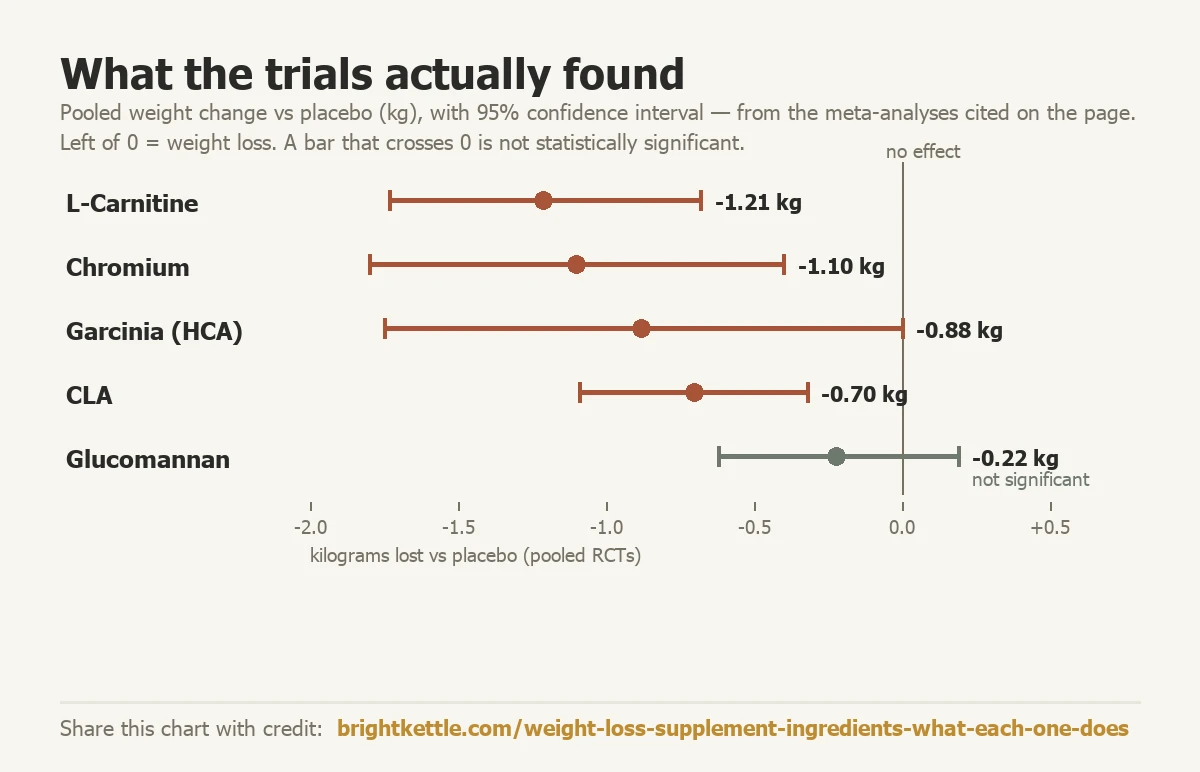
The honest takeaway: not one ingredient here beat placebo by more than about 1.2 kg in pooled trials — and green tea and glucomannan, two of the most heavily marketed, showed no statistically significant weight loss at all.
Ingredient Comparison Table
| Ingredient | Primary Mechanism | Observed Effect Size (Clinical Data) | Natural Source |
|---|---|---|---|
| Caffeine | Adenosine receptor antagonism; stimulates thermogenesis | Metabolic rate increased significantly for 3 h after ingestion; the trial does not report a percentage range (Source) | Coffee beans, tea leaves, cacao |
| Green Tea Extract (EGCG) | Proposed COMT inhibition — reviewers say the in vivo evidence for this mechanism is weak | Evidence inconclusive across studies; no significant pooled effect size reported (Source) | Camellia sinensis leaves |
| Glucomannan | Water-soluble dietary fiber; promotes gastric distension | -0.22 kg vs placebo (95% CI -0.62 to 0.19), 8 RCTs pooled; NOT statistically significant (Source) | Konjac root |
| Garcinia Cambogia (HCA) | Inhibition of ATP-citrate lyase | -0.88 kg vs placebo (95% CI -1.75 to -0.00); statistically significant, but the review calls clinical relevance uncertain (Source) | Garcinia gummi-gutta fruit |
| Conjugated Linoleic Acid (CLA) | Modulation of PPAR receptors; reduces adipocyte size | Body weight -0.70 kg (95% CI -1.09 to -0.32); fat mass -1.33 kg (95% CI -1.79 to -0.86) — two distinct, statistically significant outcomes (Source) | Dairy products, beef |
| Chromium Picolinate | Proposed enhancement of insulin sensitivity (effect on body composition debated) | -1.1 kg vs placebo (95% CI -1.8 to -0.4), 10 RCTs pooled, but the effect depends largely on one trial — excluding it gives -0.9 kg (95% CI -2.0 to 0.2), no longer significant (Source). A separate review found no demonstrated body-composition effect in healthy individuals, plus oxidative DNA damage in cell and animal studies (Source) | Broccoli, whole grains, meat |
| Capsaicin | TRPV1 receptor activation; BAT thermogenesis | +33.99 kcal/day resting metabolic rate (95% CI 15.95 to 52.03), 13 trials pooled (Source) | Chili peppers |
| Bitter Orange (Synephrine) | Beta-3 adrenergic receptor agonist | Increases resting metabolic rate and energy expenditure; modest weight loss over six to 12 weeks of use — the review reports no pooled percentage (Source) | Citrus aurantium fruit |
| L-Carnitine | Fatty acid transport into mitochondria | -1.21 kg vs placebo (95% CI -1.73 to -0.68), 37 RCTs pooled (Source) | Red meat, dairy |
Full disclosure: I went back through every citation on this page and re-checked it against the actual paper — not just the abstract's vibe, but the real numbers. A few of them didn't hold up, so I fixed them below instead of quietly leaving them wrong. Here's what each ingredient is actually doing, in plain English instead of lab-speak.
Detailed Ingredient Profiles
- Caffeine
- Caffeine's the one ingredient here I don't need a study to believe in — I've felt my own energy catch fire off a strong pour-over, then crash hard by mid-afternoon. The trial data backs the "it works" part: metabolic rate goes up significantly for a few hours after you take it (Source). What the trial does NOT hand you is a tidy percentage — so if a bottle brags about boosting metabolism by some exact number, that number isn't coming from this paper, whatever the label implies.
- Green Tea Extract (EGCG)
- I really wanted this one to be a slam dunk — Portland basically runs on green tea and self-righteousness — but the research is more "it's complicated" than the marketing lets on. The people who've actually pooled the studies call the evidence inconclusive, and the COMT-inhibition story printed on every bottle is, in their own words, backed by little in vivo evidence (Source). I still drink it. I just stopped expecting it to do the heavy lifting.
- Glucomannan
- This is the fiber supplement people swear turned their appetite off overnight, and sure, it can genuinely make you feel stuffed if you take it right before a meal — that part's just physics. But the pooled trial data landed at a loss so small it's not statistically real: -0.22 kg against placebo, and the researchers' own conclusion is that it does not show significant weight loss (Source). Feeling full isn't nothing. Just don't buy it expecting the scale to move.
- Garcinia Cambogia (HCA)
- Garcinia's one of the few here that actually cleared the statistical bar — reviewers found a real, if small, edge over placebo at -0.88 kg (Source). But even the people who ran the numbers added their own asterisk: the effect is small and its clinical relevance is uncertain. Translation — technically real, practically forgettable.
- Conjugated Linoleic Acid (CLA)
- CLA gets sold like a fat-mass-specific miracle, and there's actually some truth buried in there — the same meta-analysis found two separate, statistically real effects: -0.70 kg off body weight and -1.33 kg off fat mass specifically (Source). Just don't let a label blur those into one bigger-sounding number — they're two different measurements, and both are modest.
- Chromium Picolinate
- Chromium's the one I've gone back and forth on more than anything on this page. One meta-analysis found a real edge — -1.1 kg versus placebo (Source) — but the same authors admit that result leans hard on a single trial; drop that trial and the effect nearly vanishes and stops being significant. A separate review goes further and reports no demonstrated body-composition effect in healthy people at all, plus a flag on oxidative DNA damage in animal studies (Source). I don't take this one anymore, and if a product leans hard on chromium as its headline ingredient, that's a red flag for me now.
- Capsaicin
- The spice aisle's contribution to this list, and it's one of the more consistent performers — thirteen pooled trials found a real bump in resting metabolic rate, right around 33.99 kcal a day (Source). That's roughly the calorie burn of a brisk walk to the mailbox and back, not a transformation. I add chili to things anyway because I like the way it tastes, not because I think it's melting fat.
- Bitter Orange (Synephrine)
- This is the ingredient I'm most careful about recommending. The research does show it raises resting metabolic rate and produces modest weight loss over several weeks of use (Source) — so it's not nothing. But most of those studies stacked it with real doses of caffeine, and stimulant-on-stimulant is exactly the combination that gets people into trouble, especially anyone already on blood pressure or heart medication. If a product pairs bitter orange with a big caffeine dose, I want you talking to a doctor before you open the bottle, not after.
- L-Carnitine
- The biggest trial base on this whole list — 37 RCTs pooled together — and it actually holds up: -1.21 kg against placebo (Source). It's the one supplement here I'd call boring but legitimate, which in this industry is basically a compliment.
Last verified: 2026-07-11
None of this is medical advice — I'm not a doctor, I'm just someone who got obsessive about reading labels after one too many disappointing bottles. This page is informational, based on the published trials linked below, not a substitute for a real conversation with a professional who knows your chart. If you're on medication for your heart or blood pressure, loop in your doctor or pharmacist before adding any of these — especially bitter orange stacked with a big dose of caffeine, which is exactly the kind of stimulant pile-up that sends people to urgent care instead of toward the scale.
Sources
- Caffeine and coffee: influence on metabolic rate - PubMed
- Green Tea Extract and Fat Oxidation - PMC
- Efficacy of glucomannan supplementation - PubMed
- Garcinia Extract as a Weight Loss Supplement - PMC
- Long-term CLA supplementation and body composition - PubMed
- Chromium picolinate for reducing body weight: meta-analysis - PubMed
- The potential value and toxicity of chromium picolinate - PubMed
- Capsaicinoids/Capsinoids and thermogenesis meta-analysis - PubMed
- Human Clinical Studies Involving Bitter Orange - PMC
- Effects of l-carnitine on weight loss - PubMed